
For much of my life, I didn’t believe I was allowed to call myself depressed. The image I held of depression had been shaped by media, school, and Western portrayals: someone lying in bed all day, unshowered, crying, unable to function. That version of depression was extreme, visible, and loud—and because I didn’t match it, I believed I didn’t qualify. I thought depression meant being constantly sad, bedridden, emotionally unraveled. And because I was still showing up for school, getting things done, smiling around others—I assumed what I was experiencing didn’t count.
But what I’ve come to understand is that depression does not always announce itself.
Sometimes, it hides in plain sight.
And in many cultures—especially African and diasporic ones—it hides on purpose.
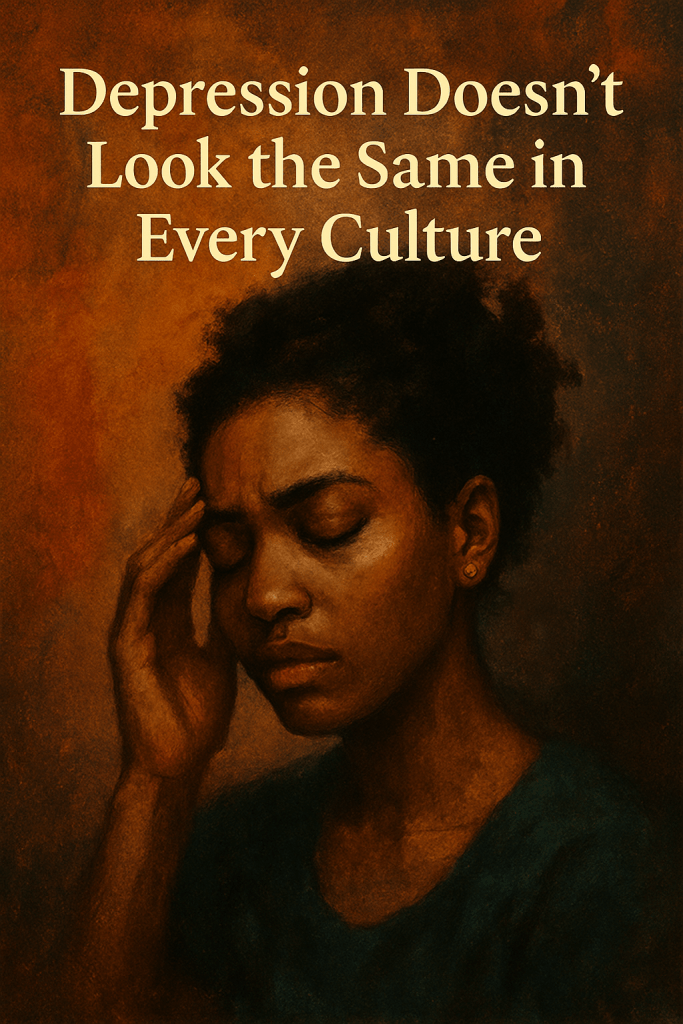
My depression has never looked like the dramatic images I grew up seeing. Instead, it’s been incredibly quiet. It manifests in sudden emotional shutdowns, waves of numbness, and recurring thoughts of self-hate. In high school, it often surfaced as rage—constant irritability, a short fuse, explosive outbursts. I didn’t understand what I was feeling then; I just knew I felt overwhelmed, disconnected, and increasingly angry. Later, it became more internal. It looked like detaching from myself and from others. Like zoning out mid-conversation. Like going through the motions while feeling like I didn’t exist.
What hurt even more was the realization that even when I tried to speak about my experience, I wasn’t heard. I was called dramatic, lazy, emotional, and grumpy. I was told to stop overreacting. That I needed to pray. That God would take care of it. And so, I did. I prayed hard—desperately, actually. I begged God to take the pain away, to make me good, to fix whatever was broken inside me. When nothing changed, I began to internalize the silence. I thought maybe I was too sinful to be saved. Maybe even God didn’t want to help me.
This kind of spiritual invalidation created a deep rupture inside of me. Not only was I suffering emotionally—I was now beginning to believe that my suffering was my fault. That I was being punished. That my pain made me unworthy of healing. This is the dangerous reality that forms when religious trauma meets untreated depression. And in many Black and African communities, it’s all too common.
Mental illness is not often recognized in my culture. It is rarely named and almost never understood. Depression is not seen as an emotional or psychological condition—it is spiritualized. When someone is withdrawn or visibly low, the assumption is that they are “under attack,” “possessed,” or in need of deliverance. What’s missing from this view is any curiosity about the emotional roots of that pain. There is no room to ask, “What happened to you?” Instead, the question becomes, “Why have you let darkness in?”
What’s tragic is that the signs were always there. Looking back now, I see depression throughout my family. My stepfather, always withdrawn, constantly working, emotionally unreachable. My mother, trying to show up for us but clearly drowning under the weight of her own unresolved hurt. The emotional dysregulation. The tension. The way so much love was buried under decades of dysfunction and trauma that had never been named, let alone addressed.
I see it now because I finally have the language. And having the language has helped me understand that I wasn’t broken—I was simply not allowed to feel.
Growing up depressed without the tools or permission to name it feels like being abandoned by the world. It doesn’t just make you feel sad. It makes you feel inhuman. I started wondering if I was a sociopath, or a psychopath, or just emotionally dead. I didn’t understand that this dark, empty feeling wasn’t evil—it was unprocessed pain. And it wasn’t just mine. It was generational.
Over time, I’ve learned how to recognize the symptoms in myself. I’ve learned how to track the warning signs: the urge to isolate, the difficulty connecting to my body, the return of intrusive self-harming thoughts. I use the Calm Harm app to ride out those waves. I create space for myself to feel without judging the feelings. I’m not healed, but I’m healing. And with that healing has come something sacred: compassion—for myself, and for others.
I now see depression in people who would never say the word. I feel it in the exhaustion behind their smiles, in the silence they sit with, in the anger that spills out when they feel ignored. And I try, gently, to offer the thing I needed most: kindness. Understanding. A way out of shame.
If there is one thing I want my culture, my family, and my future clients to understand, it’s this:
Depression doesn’t always look like you think it will.
It doesn’t cancel your accomplishments.
It doesn’t always stop your routine.
You can be high-achieving and deeply depressed.
You can function without being okay.
And most importantly:
You don’t need to be completely falling apart to deserve help.
To the people who are still attending school, working, taking care of others, showing up for everything—while quietly suffering inside: you matter.
Your pain is real.
Your depression counts.
And you are not alone.
I wish someone had told me that sooner.
I wish someone had shown me kindness when I didn’t have the words to ask for it.
So I’ll say it now:
If you are reading this, I see you. I understand you. And I’m always willing to talk.
 Diaspora Dreams
Leave a comment